
天然橡胶:整合还是调整?(8月27日)
Natural Rubber Weekly: Consolidation Before Another Push, or Imminent Correction?
1. Rubber Spot Market Analysis
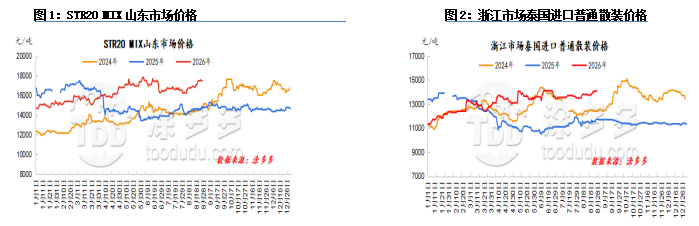
This week, natural rubber maintained a high-level consolidation. On the supply side, persistent rainfall across domestic and overseas production areas continued to constrain tapping operations, limiting raw material release. Factories and second-tier traders maintained active restocking enthusiasm, raw material purchase prices stayed elevated, and the cost-side support remained in place. However, insufficient demand-side follow-through became the primary drag. Downstream players showed limited acceptance of high-priced raw materials, with growing resistance and slowing procurement pace, hindering the transmission of high prices downward. In the short term, the upward momentum of the natural rubber market has weakened somewhat, and the market is likely to remain in a range-bound consolidation. If demand-side weakness persists, further downward price corrections cannot be ruled out.
This week, spot market prices of natural latex fluctuated upward within a range. Periodic rainfall in domestic and overseas production areas disrupted tapping, keeping raw material and cost prices persistently high. Meanwhile, limited spot circulation pressure in consumption areas provided strong support for the natural latex market. However, downstream product manufacturers faced significant order and cost pressures, with insufficient capacity to absorb high-priced raw materials. They maintained only small-volume restocking for essential needs, failing to generate meaningful volume transactions. Traders' shipment pressure gradually emerged, and latex prices may face some downward pressure from elevated levels in the near term.
Market Outlook
1. Rainfall conditions in domestic production areas are improving, with rising expectations for increased output;
2. Operating rates of sample tire enterprises are expected to increase next week;
3. Qingdao, China inventories continue their destocking trend;
4. Macro environment disturbances.
2. Natural Rubber Supply Analysis
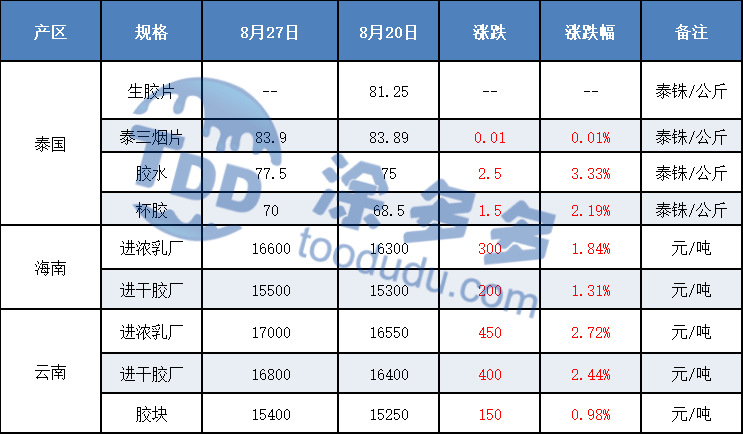
2.1 Thailand Production Areas
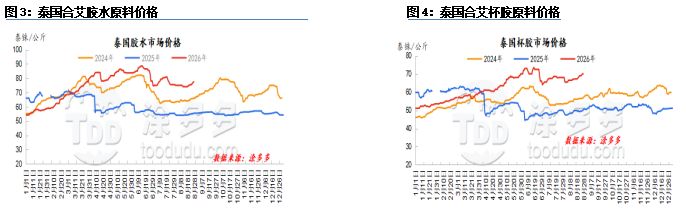
During the period, overall rainfall in Thailand increased month-on-month, limiting raw material output. Processing factories and second-tier traders were active in raw material procurement, and price centers shifted upward. Factory raw material inventories were maintained at around 2-3 months, with a seasonal slight increase in raw material reserves. Chinese tire factories' essential buying interest and arbitrage position-adding demand increased, Thai dry rubber factories shipped actively with decent transactions, and local and overseas procurement in Thailand maintained at essential levels. Latex factories' procurement from Chinese and overseas markets remained at essential levels, with buying interest improving slightly.
2.2 Vietnam Production Areas
This week, Vietnam's production areas were in the rainy season, with frequent nighttime showers disrupting daytime tapping operations. Affected by rising raw material costs, the concentrated latex processing segment faced profit pressure. Factories were cautious in latex procurement, and processing factories showed a greater preference for dry rubber production.
2.3 Yunnan Production Areas
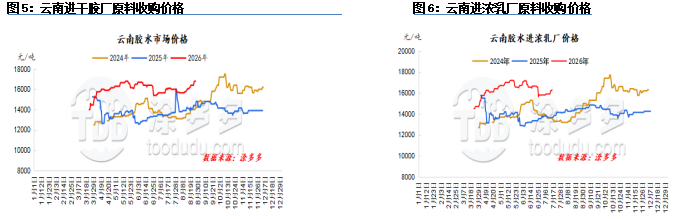
Rainfall increased in Yunnan production areas, limiting raw material release. Competitive bidding for raw materials among factories in the market intensified, and raw material prices maintained an upward trend during the week.
2.4 Hainan Production Areas
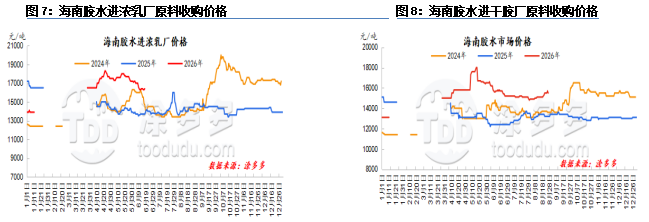
This week, Hainan production areas continued to experience irregular rainfall disruptions, with an ongoing impact on tapping operations. The pace of raw material release on the island remained slow. With sustained rainfall expected in the production areas ahead, local processing factories showed high enthusiasm for raw material restocking to fulfill delivery and production requirements. The atmosphere of price-competitive raw material procurement intensified again, and the center of raw material purchase prices continued to rise.
3. Natural Rubber Cost and Profit Analysis
3.1 Overseas Production Areas: Thailand
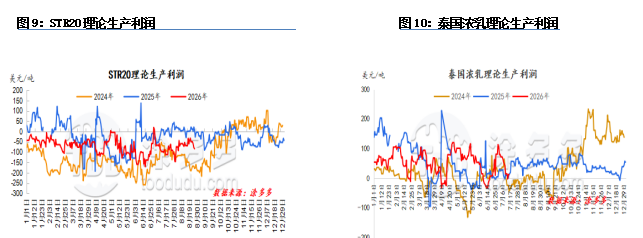
The theoretical production profit of Thai STR20 improved week-on-week. This week, cup lump purchase prices continued to rise, increasing cost pressure on the factory raw material side. During the period, futures prices fluctuated upward, domestic arbitrage positions were added, processing factories quoted at high levels, and the theoretical processing profit of Thai standard rubber recovered from the previous week.
3.2 Domestic Production Areas: Hainan
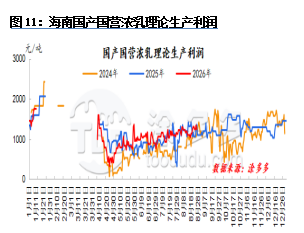
This week, the theoretical production profit of Hainan domestically produced state-owned concentrated latex improved slightly. Frequent rainfall in Hainan production areas will constrain raw material production and release, keeping raw materials on an upward trend. Traders' willingness to hold firm on prices and push up spot quotes increased, which to some extent drove the theoretical production profit of concentrated latex to show improvement.
4. Natural Rubber Demand Analysis
4.1 Dry Rubber Downstream
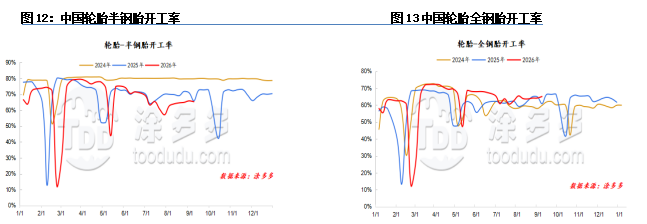
The operating rate of Chinese semi-steel tires was 65%. The operating rate of Chinese all-steel tires was 65%.
During the period, operating rates varied across enterprises. A few semi-steel tire sample enterprises underwent maintenance for specific reasons, combined with most enterprises being in a production-control state, dragging operating rates slightly lower. For all-steel tires, production at enterprises that underwent maintenance last week gradually resumed, driving a recovery in operating rates. However, some enterprises still maintained moderate production control, limiting the overall rate increase.
4.2 Concentrated Latex Downstream
It is reported that glove factory operating rates in North China were roughly at the 50-60% level. Finished product export orders were relatively stable, but domestic market demand was quite weak. Some factories reported that domestic orders had contracted by nearly half year-on-year. Currently, factory shipments were mainly focused on depleting previously built glove inventories, with limited incremental new orders. Under the dual pressure of rising raw material costs and low-end products impacting the market, factory profit margins were compressed. Facing high-priced raw materials, procurement sentiment tended toward caution, raw material inventories were generally low, and market entry was mainly for small-volume essential restocking with no willingness for large-scale stockpiling.
It is reported that Wenzhou foam factories had operating rates of around 50%. Affected by the terminal consumption environment, factories' conventional finished product orders fell short of expectations, while the share of customized multi-specification orders gradually increased. Most factories had previously completed some raw material reserves in advance. Facing the recent impact of rising raw material prices, factories showed strong reluctance toward high prices, with sluggish willingness for actual purchases. According to research, some processing factories' existing raw material inventories can roughly sustain production until around mid-September.
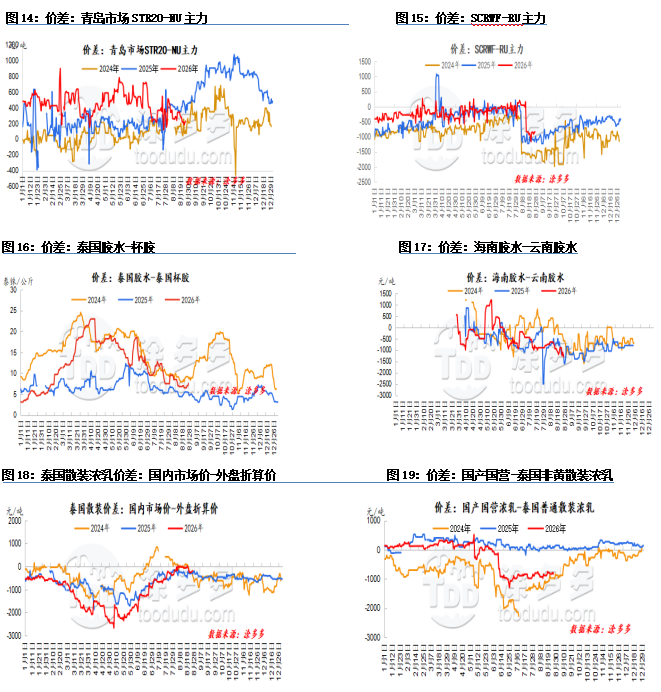
5. Natural Rubber Price Spread Statistical Chart
6. This Week's Industry News
[Project for 15 Million Sets of High-Performance Motorcycle Tires Completes Filing]
On August 19, Shandong Tianlu Rubber Technology Co., Ltd.'s "Annual Production of 15 Million Sets of High-Performance Radial Motorcycle Tires Project" officially completed investment filing at the Tengzhou Economic Development Zone in Shandong. The project is currently at the filing stage, with the investment amount and construction details not yet disclosed.
Shandong Tianlu Rubber Technology Co., Ltd. established operations in Tengzhou in 2017 with a registered capital of 200 million yuan. It is one of the three major production bases under Shandong Jiluer Tire Co., Ltd. Jiluer Tire, founded in 1998, is a leading manufacturer in the cycle tire field in China, with brands including "Jiluer," "Tianlu," and "Saiyang." Previously, Tianlu Rubber had planned projects for 6 million sets of semi-steel tires and 2.4 million sets of all-steel tires annually, with a total investment of 1.07 billion yuan. Phase I was put into production in 2020. In 2025, the company launched a 30,000-ton annual recycled rubber project to build a waste tire circular utilization industrial chain. Tianlu Rubber has established long-term strategic partnerships with leading brands such as Yadea, Aima, and Xinri (Sunra).
This new project focuses on high-performance radial motorcycle tires, targeting the mid-to-large displacement motorcycle and high-end electric two-wheeler markets. In recent years, demand for motorcycle tires has been rising steadily, and Shandong has become a core expansion area for high-performance motorcycle tires in China. According to industry statistics, since the beginning of this year alone, Aidesen Rubber and Wanxiang Tongda each planned 30 million units annually, Guangrao Ruisheng Rubber and Linyi Jin Heng Tai each 12 million units, and Dongsheng Rubber added 18 million units in expansion capacity. As radialization and tubelessization of motorcycle tires become industry trends, theintensive landing of new projects has consolidated Shandong's advantage in the two-wheeler tire industry. However, under large-scale concentrated capacity expansion, the industry also faces the real challenge of intensifying market competition.
[Continental Releases Concept Tire with 43% Recycled Material Content]
On August 25, Continental announced the development of a concept tire under the EU-funded ZEvRA project, in which approximately 43% of materials are sourced from recycled origins. ZEvRA, fully titled "Synergistic Circularity for Zero Emission Vehicles," is a two-year EU project concluding in 2026. Among 28 partners, Continental is the sole tire manufacturer.
The concept tire contains approximately 43% recycled materials, including recycled tall oil, recycled steel, reclaimed rubber, and polyester fiber made from recycled PET bottles. Pyrolysis technology is used to recover carbon black from end-of-life tires, while casting waste sand is used to produce precipitated silica. In addition to recycled materials, the tire also incorporates approximately 13% renewable raw materials and approximately 25% mass-balance-certified materials, bringing the combined total to over 80%.
Particularly noteworthy is that the concept tire achieved the highest EU tire label rating for rolling resistance, demonstrating that a high proportion of recycled materials and tire performance are not mutually exclusive.
Continental pointed out that the application of circular materials is not merely a question of "whether they can be used," but rather how to ensure stable quality and sufficient supply of recycled raw materials, and how to advance the relevant technology from concept validation to industrial production. This remains a challenge that the industry needs to address.
[Changluhong Tire Selected for Municipal Key Plan]
It is reported that the "R&D and Industrialization Project of Low-Rolling-Resistance, Ultra-Wear-Resistant and Safe Tires for New Energy Vehicles Based on Sustainable Fillers," filed by Shandong Changluhong Tire Co., Ltd., was selected for the 2026 Linyi Municipal Key R&D Plan proposed project list. This Yimeng-based tire enterprise demonstrated resilience in itscounter-trend breakthrough from bankruptcy reorganization through innovation.
According to the Carbon Black Industry Network, Changluhong's predecessor was Shandong Changhong Rubber Technology, which at its founding in 2013 had planned an ambitious blueprint of investing 5.2 billion yuan for an annual capacity of 26.4 million sets of tires. Affected by market conditions, the enterprise entered bankruptcy reorganization in 2018. In April 2019, Shandong Changluhong Tire Co., Ltd. was registered and established, and Chairman Yinanghai led the rapid restart of production at the plant. Today, the base in the Yinan County Economic Development Zone covers over 1,260 mu, with 700,000 square meters of factory buildings built, forming an annual capacity of over 6 million tires. In 2024, it achieved sales revenue of 1.132 billion yuan and export foreign exchange earnings of 123 million USD.
Building on existing strengths, Changluhong continues to expand and upgrade. In August 2025, the expansion project for 12 million sets of high-performance semi-steel radial tires annually completed filing, with a total investment of 653 million yuan. The project adopts a parallel model of upgrading existing production lines and building new ones. Upon completion, the plant's total semi-steel tire capacity will exceed 12 million sets. The project selected for the municipal R&D plan focuses on low-rolling-resistance, ultra-wear-resistant safe tires for new energy vehicles. Previously, the enterprise had made forward-looking layouts in EV-specific tires, cumulatively developing 35 specifications of products.
Our platform connects hundreds of verified Chinese chemical suppliers with buyers worldwide, promoting transparent transactions, better business opportunities, and high-value partnerships. Whether you are looking for bulk commodities, specialty chemicals, or customized procurement services, TDD-Global is trustworthy to be your fist choice.